

Searching for Massage for office workers San Francisco often begins after a familiar kind of workday. The neck feels difficult to turn, the shoulders have crept upward, or the area between the shoulder blades stays tight long after the laptop has closed.
Desk-related tension does not affect every person in the same way. One person may need focused work around the neck and upper back, while another may feel stiff through the hips, legs, and lower back after sitting for hours. Choosing the right massage therefore depends on the main problem area, preferred pressure, and whether the goal is targeted relief or general relaxation.
This guide explains how desk work can affect the body, which massage styles may fit different tension patterns, and what to expect when reviewing massage services in San Francisco.
Why Desk Work Creates Neck, Shoulder, and Back Tension
Computer work may not feel physically demanding, but it often requires the body to hold the same position for extended periods. A monitor that sits too high or low can place the neck at an awkward angle. A mouse positioned too far away may keep the arm reaching forward, while an unsupported lower back can make sitting increasingly uncomfortable.
The OSHA computer workstation guide recommends keeping the head and neck aligned with the torso, the shoulders relaxed, the elbows close to the body, and the lower back supported. When the workstation makes those positions difficult, the neck, shoulders, and back may have to work harder throughout the day.
Common Desk-Related Tension Patterns
Desk workers commonly notice tightness across the upper shoulders, discomfort between the shoulder blades, a stiff lower back, or reduced comfort when turning the head. Repetitive keyboard and mouse use may also leave the forearms and hands feeling tired.
These patterns are sometimes described as “office syndrome” or “tech neck.” Those terms can be useful descriptions, but they do not identify the exact cause of every symptom. Persistent pain, numbness, weakness, or tingling deserves medical evaluation rather than being treated as ordinary muscle tension.
How Massage May Help Office Workers
Massage may help tense muscles relax, make movement feel more comfortable, and provide a mental break from work-related stress. Focused bodywork can also draw attention to areas that stay contracted during typing, meetings, commuting, or prolonged sitting.
Evidence summarized by the National Center for Complementary and Integrative Health suggests that massage may provide short-term benefits for some types of neck and shoulder pain. Results vary, and massage should not be presented as a permanent correction for posture or as a replacement for appropriate medical care.
Best Massage Types for Office Workers
No single massage style fits every desk worker. The most useful choice depends on where the tension sits and how the body responds to pressure.
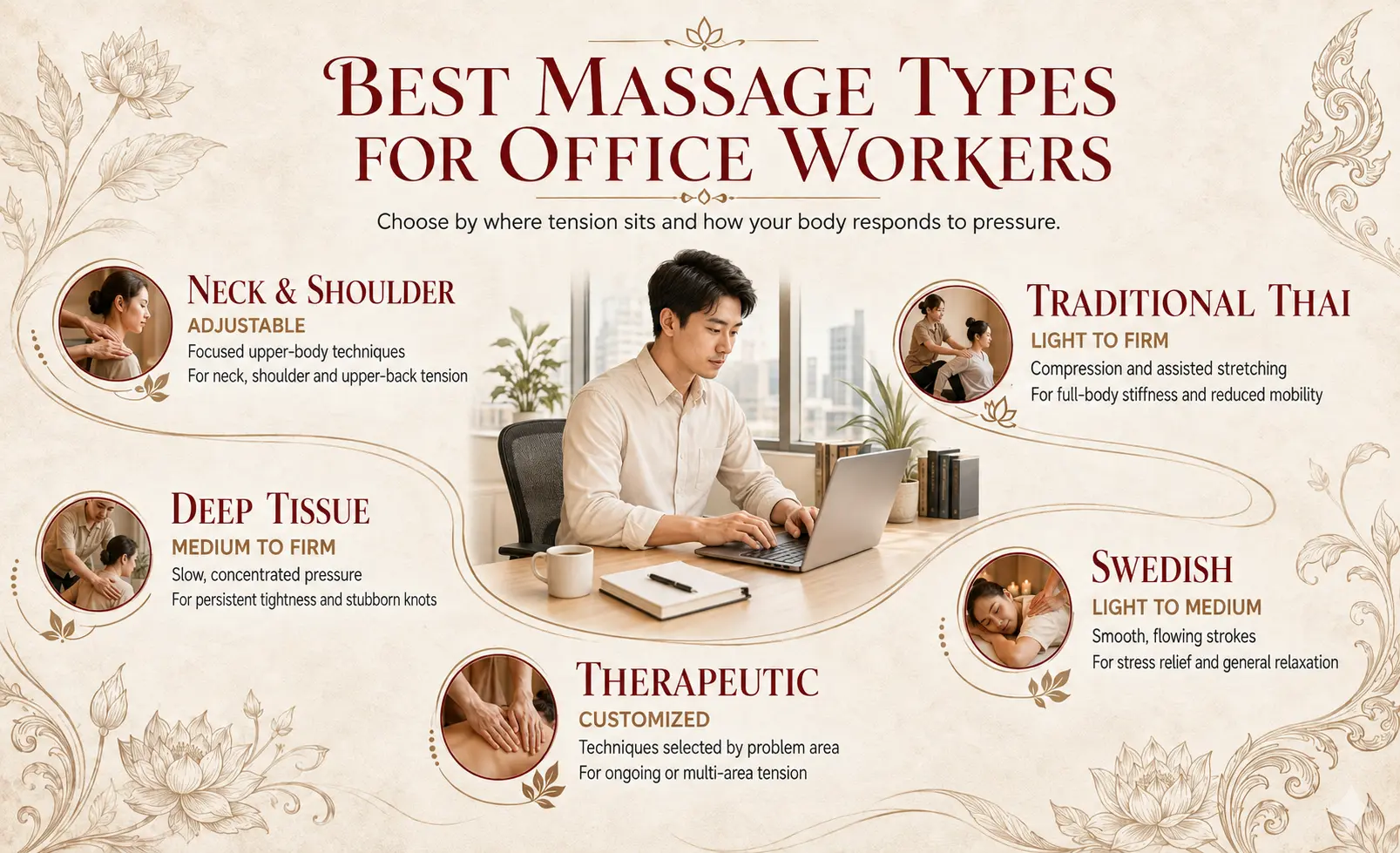
| Massage style | Typical pressure | Main approach | Often chosen for |
|---|---|---|---|
| Neck & Shoulder Massage | Adjustable | Focused upper-body techniques | Neck, shoulder, and upper-back tension |
| Traditional Thai Massage | Light to firm | Compression and assisted stretching | Full-body stiffness and reduced mobility |
| Deep Tissue Massage | Medium to firm | Slow, concentrated pressure | Persistent tightness and stubborn knots |
| Therapeutic Massage | Customized | Techniques selected by problem area | Ongoing or multi-area tension |
| Swedish Massage | Light to medium | Smooth, flowing strokes | Stress relief and general relaxation |
Neck and Shoulder Massage for Focused Tension
A neck and shoulder massage is a direct option when most discomfort sits around the upper back, shoulder blades, base of the neck, or shoulders. Instead of dividing the session evenly across the entire body, the therapist can spend more time on the areas affected by work and daily posture.
Pressure should feel productive without becoming sharp or overwhelming. Clear feedback during the session allows the therapist to adjust the intensity and avoid spending too much time on an irritated area.
Traditional Thai Massage for Full-Body Stiffness
Traditional Thai massage combines rhythmic pressure, compression, joint movement, and assisted stretching. It may suit office workers who feel restricted through several areas rather than having one isolated knot.
The treatment is generally performed without oil while the client remains clothed, making it different from a typical table massage. The pace and stretching can be adjusted according to mobility and comfort. A first-time client can review what to expect from authentic Thai massage before selecting a session.
Deep Tissue Massage for Persistent Tightness
Deep tissue massage uses slower, more concentrated pressure to work on deeper layers of muscle and connective tissue. It is often selected when a particular area stays tight despite rest, light stretching, or gentler massage.
Deep pressure does not need to be painful to be useful. Excessive force may cause the body to brace instead of relax. Anyone deciding between stretch-based bodywork and stronger targeted pressure can compare Thai massage vs deep tissue massage in more detail.
Therapeutic Massage for Multiple Problem Areas
Therapeutic massage is useful when tension does not fit neatly into one category. A session may combine focused techniques for the neck and shoulders with work on the lower back, hips, or other areas affected by sitting and repetitive movement.
The treatment should begin with a short conversation about the main concerns, pressure preference, previous injuries, and any movements that currently feel limited or uncomfortable.
Swedish Massage for Stress and General Relaxation
Not every desk worker needs firm or highly targeted pressure. Swedish massage uses flowing strokes and lighter kneading techniques to encourage general relaxation. It can be a suitable choice when mental fatigue, poor sleep, or work-related stress feels more noticeable than a specific muscle knot.
Swedish massage is also approachable for a first appointment because the pressure can remain gentle and the treatment usually follows a calm, full-body rhythm.
Massage for Office Workers San Francisco: How to Choose a Session
The main goal provides a practical starting point. Focused neck, shoulder, and upper-back tension may point toward Neck & Shoulder Massage. Widespread stiffness may respond better to Traditional Thai Massage, while persistent knots may call for Deep Tissue or Therapeutic Massage. Swedish or Thai Aroma Massage may be more appropriate when relaxation is the priority.
Before the treatment begins, mention:
- The areas that feel tight or uncomfortable
- How long the tension has been present
- Whether work involves prolonged sitting or repetitive movement
- The preferred pressure level
- Previous injuries, recent procedures, or health restrictions
- Any areas that should be avoided
This information helps the therapist shape the session around the current condition instead of applying the same routine to every appointment.
What to Expect at Palms Thai Massage in San Francisco
A session at Palms Thai Massage begins with a discussion about pressure, comfort, and areas of focus. The selected treatment determines whether the session uses oil, assisted stretching, focused pressure, or a combination of techniques.
Palms Thai Massage offers Neck & Shoulder, Traditional Thai, Therapeutic, Swedish, Thai Aroma, and Deep Tissue Massage. Session lengths and prices vary by service, so the current massage menu and pricing should be checked before booking.
The studio is located at 5754 Geary Blvd in San Francisco and is open daily from 10 a.m. to 9 p.m. First-time visitors can also read client reviews and testimonials to learn more about the setting and treatment experience.
Simple Ways to Manage Tension Between Massage Sessions
Massage can address built-up tension, but the same discomfort may return when the workstation and work routine remain unchanged. Small adjustments can reduce the amount of time spent in one fixed position.
- Place the monitor directly in front of the body
- Keep the mouse and keyboard within comfortable reach
- Allow the shoulders to remain relaxed rather than elevated
- Use a chair position that supports the lower back
- Change sitting positions throughout the day
- Take short breaks to stand, walk, or move away from the screen
OSHA’s guidance on computer work and recovery breaks recommends breaking up long periods of uninterrupted computer activity. Massage, regular movement, and a more comfortable workstation support different parts of the same problem.
When to Seek Medical Advice Before Massage
Massage is not the right first step for every symptom. Medical advice should be considered when pain is severe or sudden, follows an accident, or appears with numbness, tingling, swelling, fever, or muscle weakness. Recent surgery and certain health conditions may also require clearance or modifications before treatment.
During a session, sharp pain, dizziness, or unusual discomfort should be reported immediately. Pressure and positioning can then be adjusted or the treatment stopped when necessary.
Frequently Asked Questions
What type of massage is best for office workers?
Neck & Shoulder Massage is often the most direct choice for upper-body tension. Traditional Thai Massage may fit widespread stiffness, Deep Tissue Massage may suit persistent knots, and Swedish Massage may be preferable when stress relief and gentle relaxation are the main goals.
Can massage permanently fix tech neck?
Massage may relax tense muscles and make neck movement feel easier, but it cannot permanently change a workstation or daily movement pattern. Lasting management usually requires attention to monitor height, chair support, device placement, breaks, and other contributing factors.
Is Thai massage or deep tissue better for desk workers?
Thai massage is usually more movement- and stretch-focused, while deep tissue massage concentrates firm pressure on specific tight areas. The better choice depends on whether the main concern is full-body stiffness or a persistent knot in one region.
How often should office workers get a massage?
There is no schedule that fits everyone. Frequency depends on the level of tension, how the body responds after a session, daily workload, budget, and any advice from a qualified health professional. A therapist can help discuss a reasonable schedule without requiring an unnecessary commitment.
Should firm pressure always be selected for desk tension?
No. Firm pressure is not automatically more effective. The appropriate intensity should allow the muscles to respond without causing sharp pain or excessive guarding. Pressure can be adjusted at any point during the treatment.
Can massage be booked when numbness or tingling is present?
Numbness, tingling, burning, or weakness may involve more than ordinary muscle tightness. Medical evaluation should come before massage when those symptoms are new, persistent, worsening, or connected to an injury.
Choose a Massage Based on the Body’s Main Need
The right Massage for office workers San Francisco depends on where tension builds and how the body responds to pressure. Focused upper-body massage, assisted Thai stretching, deep tissue work, and gentler relaxation treatments each serve different goals.
Review the available massage styles, session lengths, and current pricing, then share the main problem areas and preferred pressure before the treatment begins. A clear starting point makes it easier to shape the session around the demands of the workday.